
Permeability is not an intrinsic property of the molecule, but the result of the interaction between the molecule, the chosen model and the experimental context. The real question is not which model is correct, but which one answers what you need to know.
The challenge: permeability is not a universal number
A compound with proven in vitro potency frequently fails in vivo because the molecule cannot cross the cellular or tissue barrier as expected. Permeability is not an intrinsic property of the molecule, but the result of the interaction between the molecule, the chosen model and the experimental context.
A permeability value obtained in one model may not hold in another. The real question is not which model is correct, but which one answers what you need to know.
2D models: cost, throughput and a direct answer
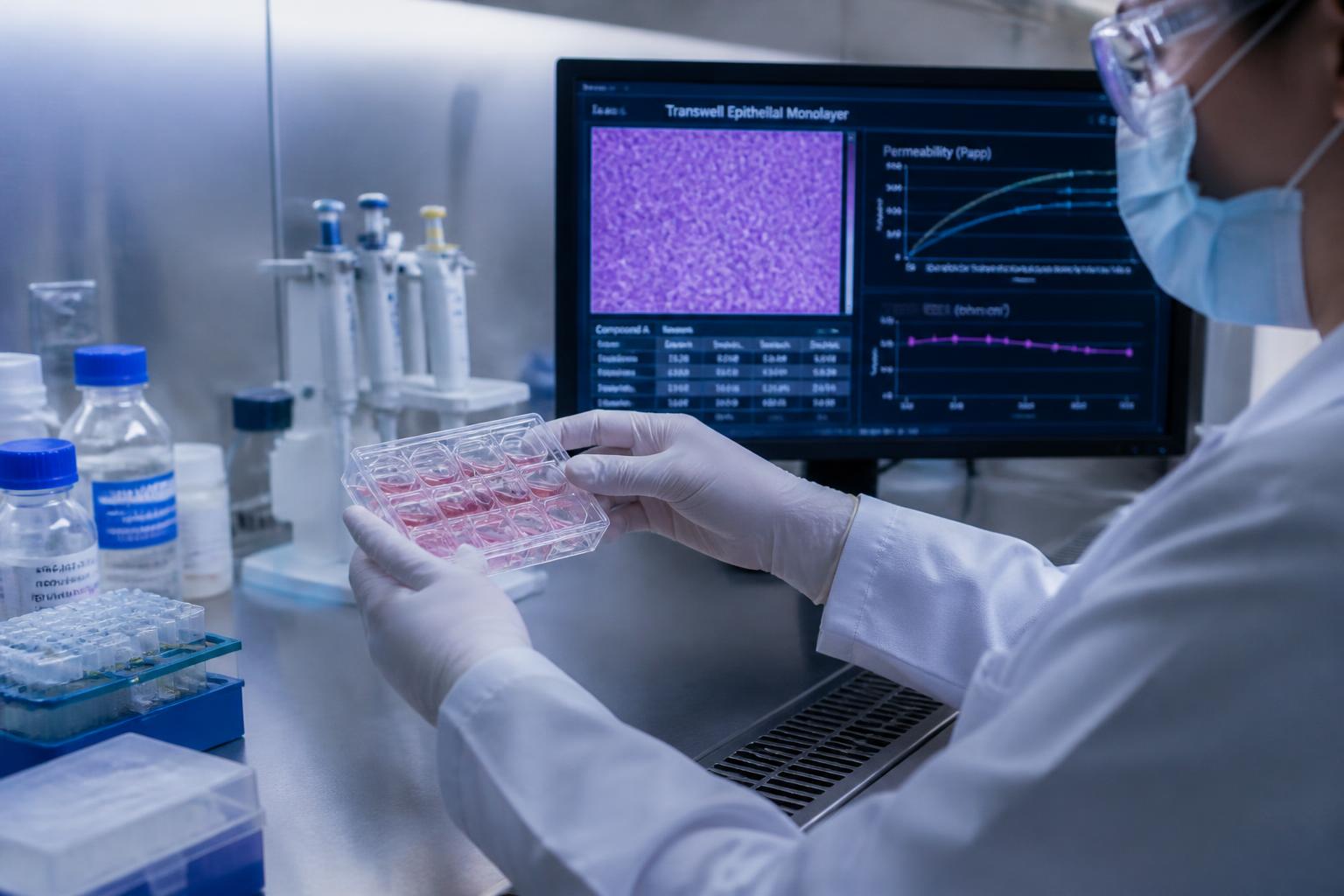
Transwell monolayers with TEER remain the standard choice for initial screening. They are reproducible, economical, allow multiple candidates to be tested and correlate well with in vivo absorption, especially for small molecules with well-defined transport.
The literature establishes that Caco-2-based 2D models predict oral absorption with acceptable precision. MDCK cells transfected with specific transporters offer fast culture without losing selectivity. These systems work because they isolate the question: does this molecule cross this barrier under these conditions?
What 2D does well:
- Characterizes passive transport precisely
- Identifies substrates of the main transporters (P-gp, BCRP, OATP)
- Allows multiple candidates to be tested within controlled time and cost
- Delivers reproducible data across laboratories when standardized
Limitations: monolayers lack oxygen gradients, perfusion and contact between different cell types. Measured permeability may not reflect real tissue, especially when absorption involves interactions that only occur in a more complex context.
3D models: physiological relevance and complexity
Organoids, spheroids and co-cultures add nutrient and oxygen gradients plus contact between different cell types. This changes transporter expression and signaling pathways.
An epithelial cell isolated in 2D expresses a different set of transport genes compared to the same cell next to immune cells in 3D. Local cytokines, cell-cell contact and hypoxia modify which pathways are active and therefore affect permeability.
When 3D adds value
- Candidate validation before in vivo testing
- Molecules with receptor-mediated transport
- Gene therapies, mRNA and lipid nanoparticles
- Penetration-dependent toxicity assessment
- Systems requiring a local immune response
What it costs: 3D models take 3 to 4 weeks of culture, require STR authentication, show higher lot-to-lot variability and demand deeper technical expertise to validate barrier integrity.
The critical question: what are you actually asking?
Choosing the right model starts with clarity about what you want to know.
Does my candidate cross the membrane?
Use 2D Transwell. Fast, economical: you obtain Papp (permeability coefficient), detect efflux and test saturation. Data in days.
Is my biologic actually taken up and functional?
Here 2D is not enough. Large proteins do not penetrate monolayers. 3D models with epithelial and immune cells show whether uptake happens, whether there is movement between cells, whether inflammation emerges. It takes weeks, but answers the right question.
What does my candidate do in a more realistic environment?
Test in 3D after characterizing well in 2D. Confirm whether the transport measured in 2D holds with real architecture, or whether you uncover limitations 2D did not show.
Quality control: where artifacts hide
Regardless of the model, reproducibility depends on rigor that is frequently neglected.
Cell line authentication
Contaminated cells can go unnoticed. If a result diverges sharply from the literature, contamination is the first suspicion. STR is not a luxury: it is mandatory before important experiments.
Controlled passage
Between P15 and P25, ABC transporters and tight junctions begin to degrade in common cell lines. TEER may still look acceptable while basal permeability rises. Protocols with a maximum passage limit make a difference.
Culture standardization
Different fetal serum lots, medium pH, incubator gases: each affects permeability. Two labs testing the same molecule in Caco-2 can obtain very different results if culture conditions vary.
Pre-experiment integrity
Viability above 95%, TEER within range, confirmed confluence. Obvious on paper, frequently skipped under schedule pressure.
Integrating 2D and 3D into a coherent strategy
The most robust approach does not choose between 2D and 3D, but uses them sequentially as the question evolves:
- Phase 1 — Screening (2D). Transwell in an appropriate cell line (Caco-2 for oral absorption, transfected MDCK for a specific transporter). Goal: qualify candidates, discard those with very high barriers. Fast and cheap.
- Phase 2 — Mechanistic validation (rigorous 2D). Bidirectional assays, transport blockers, saturation testing. Find out which mechanism is operating. Still 2D, but deeper.
- Phase 3 — Closer to reality (3D when it makes sense). For promising candidates where permeability may be limiting, validate in organoids or spheroids. Check whether transport holds with real architecture and gradients.
This approach saves resources: you do not test everything in 3D from the start, but validate what matters in a model that captures complexity.
When permeability is truly limiting
Permeability is not always the critical factor. Sometimes it is just one of the dimensions.
Molecules with passive or main-transporter transport
2D permeability correlates well with in vivo. A well-characterized 2D model is sufficient.
Peptides and small proteins
They depend on specific transporters (PEPTs, receptors). Identifying which transporter is critical. 2D with the correct transfected line answers it; 3D validates.
Large biologics and nanoparticles
They are impermeable in 2D alone. Here 3D with immune cells or a route-relevant co-culture (oral, systemic) makes the difference.
Therapies with immunological action
If your candidate modulates immunity, an epithelial cell alone underestimates the response. Co-culture with immune cells changes everything.
The point: choosing a model because 3D is more realistic, without specific justification, is as problematic as choosing only 2D for cost reasons without considering the biology of the molecule.
Inter-laboratory reproducibility: the silent problem
When studies compare the same drug across several laboratories, results often diverge substantially. It is rarely bad science; it is different execution.
Cell passage, fetal serum lot, pH, gases, even the insert brand: everything matters. One lab uses P8, another P20. One tests in DMEM + serum, another in HBSS. Same cell line, very different environments.
This is not exclusive to 2D. 3D models have even higher variability. The point is that permeability is not a fixed number for a molecule, it is the response under that specific protocol.
That is why data are only comparable when the protocol is well documented. Publishing Papp = 5 × 10⁻⁶ cm/s without describing cell line, passage, medium and conditions is worth little.
Emerging perspectives
Organs-on-chip and more sophisticated reconstructions
Chips with continuous perfusion, multilayer tissues and iPSC-derived systems are starting to bring in vitro closer to in vivo. Still expensive and complex, but growing.
Computational prediction
Machine learning combining chemical structure with transporter profile can predict permeability of new candidates. Useful as screening before going to the bench.
Higher rigor in authentication
Slowly, the requirement for STR, sequencing and barrier validation before publication keeps increasing.
Synthesis: aligning rigor with cost
Permeability deserves attention proportional to its impact on the candidate. Investing well here saves months later. Clinical failures from inadequate bioavailability are expensive.
But adequate is not maximum. A fast screening does not need 3D. A promising biologic with uncertain transport deserves more than 2D.
The pragmatic approach is:
- Well-executed 2D for screening when transport is passive or via a main transporter
- 2D + controls when the mechanism is less obvious
- 3D to validate when the candidate advances and you sense permeability may be a problem, or when the biology demands a more complex context
No model is universally correct. The correct one is the model that answers your question without wasting resources on unnecessary complexity.
If you are developing a molecule where permeability may be limiting and you are unsure which model to start with, it is worth talking to people who do this every day.