
With BRCA1 and BRCA2 widely offered by the Brazilian public health system, hereditary cancer genetic testing became public policy. Learn how your clinic can deliver the same quality standard without building its own molecular biology infrastructure.
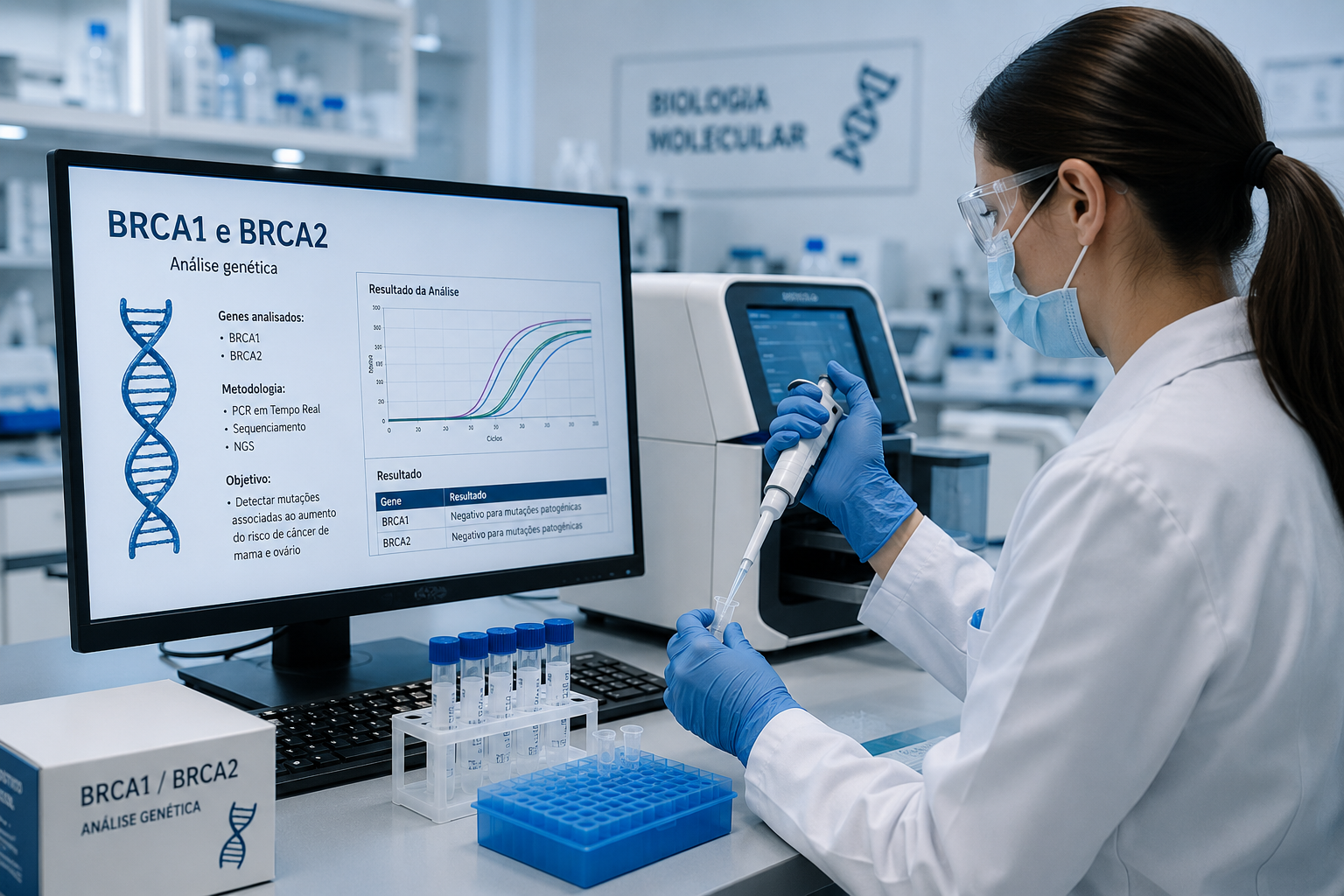
A structural shift in access to hereditary cancer genetic diagnosis
When the Brazilian public health system began offering BRCA1 and BRCA2 testing at scale, it created a new scenario in Brazil: regulatory-quality genetic diagnosis stopped being a privilege of specialized research centers. It became public policy.
What does this mean for your clinic, practice or laboratory? Your patients now expect you to offer this test with the same safety as the public system. And you can — without building your own molecular biology infrastructure.
What BRCA1 and BRCA2 are, and why your patient needs this test
BRCA1 and BRCA2 are tumor suppressor genes. Mutations in these genes significantly increase the risk of breast cancer, ovarian cancer and other neoplasms. A woman with a BRCA1 mutation has up to an 87% lifetime risk of developing breast cancer — compared to approximately 13% in the general population.
BRCA genetic testing is currently indicated for:
- Women with a family history of breast or ovarian cancer
- Women diagnosed with breast cancer before age 45
- Carriers of a second neoplasm
- Risk stratification in personalized screening programs
- Surveillance and prevention planning (prophylactic mastectomy/oophorectomy)
The public system democratized access, but demand for proven-quality testing remains high in private clinics, oncology practices and diagnostic support laboratories.
Why your clinic or laboratory should offer BRCA1 and BRCA2
Reason 1: Patient expectation
Your patients already know this test exists. Many come with a public system referral or documented family history. If your clinic does not offer it, they look elsewhere — and take the clinical relationship with them.
Reason 2: Regulatory compliance is now mandatory
ANVISA is intensifying inspections of molecular diagnostic laboratories. Proven quality is a prerequisite, not a differentiator. You need tests performed in a laboratory with method validation under ICH Q2(R2) and auditable traceability.
Reason 3: Preventive medicine is profitable and builds loyalty
A patient who discovers her genetic risk condition will need continuous surveillance — ultrasounds, MRIs, eventually preventive procedures. It is a long-term relationship with recurring demand.
The problem: how to offer it without building a lab?
This is the dilemma we hear every week from clinicians and managers of smaller laboratories:
“We want to offer BRCA1 and BRCA2 to our patients. But we don't have sequencing infrastructure, we don't have molecular genetics expertise, we can't build an ANVISA-compliant laboratory — and we certainly won't do it just for this one test.”
That is exactly the barrier Base Científica solves.
How you offer BRCA1 and BRCA2: the Base Científica solution
Base Científica operates as advanced scientific engineering in molecular biology. You:
- Order the test for your patient — the sample is collected at your clinic/laboratory (blood or saliva)
- We handle the rest — method validation, processing, sequencing, variant interpretation under ACMG guidelines, structured clinical report
- You deliver the structured result — with clinical interpretation, follow-up indications and support for the discussion with the patient
We provide:
- Regulatory validation: all protocols developed under ANVISA/ICH Q2(R2), with auditable documentation
- Variant interpretation: analysis under ACMG/ASCO guidelines, including discussion of incidental findings and surveillance recommendations
- National logistics: collection at your clinic, processing in a certified laboratory, results within clinical turnaround times
- Structured reports: ready for integration into the electronic medical record, with clear language for the patient and a protocol for the physician
It is like outsourcing laboratory engineering — you keep the clinical relationship, we provide the technology with regulatory compliance.
Why choose Base Científica
Because we are not just a laboratory that processes samples. We are specialists in:
- Preclinical and molecular diagnostics — our PhDs and specialists understand assay design, analytical validation and genomic data interpretation
- Regulatory compliance — we work with pharmaceutical and biotech companies that require ANVISA/FDA/ICH as the standard
- Women's health — BRCA is one of our focus areas, along with HPV (28 genotypes), STIs, fetal sexing and genetics
When you refer a patient to us, they do not enter a generic queue. They enter a structured genomic medicine program with robust scientific support.
Getting started with BRCA1 and BRCA2
If your clinic or laboratory wants to start offering this test to patients, we can discuss sample format, turnaround and report structure. No infrastructure is required on your side — just a conversation about integrating this into your clinical portfolio.
Base Científica offers molecular diagnostics and women's health as one of five pillars of scientific engineering. We work with clinics, laboratories and reference centers that want to offer genetic testing with regulatory compliance — from BRCA1 and BRCA2 to HPV, STIs, fetal sexing and custom clinical genetics panels.
You don't need to build a laboratory to offer regulatory-quality testing to your patients. You just need a reliable scientific partner.
Ready to offer BRCA1 and BRCA2 to your patients?