
What separates a reliable result from a misleading number in ELISA: the assay format, the antibodies, the matrix effect, the reference curve and the readout alongside cell viability assays.
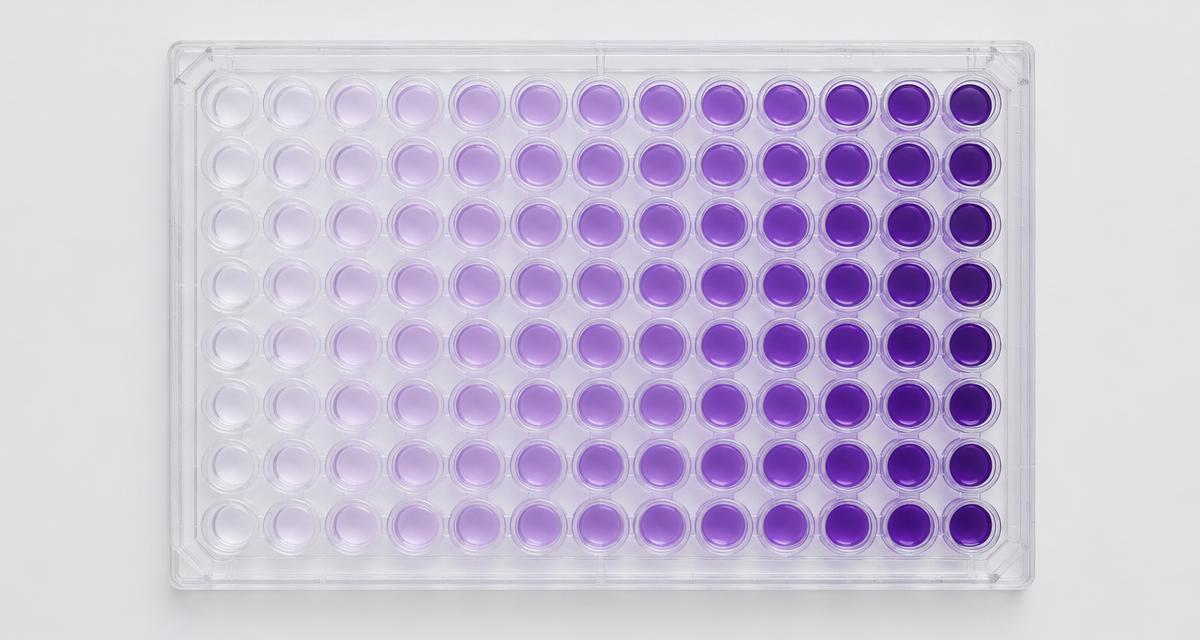
Few techniques are as widespread in research as ELISA. It measures proteins linked to inflammation, to the immune response, to a compound's mechanism of action or to biomarkers, as well as hormones, antibodies, drugs and other molecules present in a sample. The principle can be explained in a few lines: an antibody recognises the molecule of interest, an enzyme turns that recognition into colour, and the intensity of the colour indicates how much of it is there.
This apparent simplicity creates the impression that following the protocol is enough. In practice, the number that appears at the end is the result of a series of choices made before, during and after the assay. Each one can bring the result closer to what actually happens in the sample or push it away, without anything seeming wrong at first glance.
Each target calls for its own format
There is more than one type of ELISA, and the first choice is which to use. The most common, called sandwich, traps the protein between two antibodies that bind to different points on it. Requiring two recognitions at the same time makes the assay more selective, and that is why it is the preferred format for measuring proteins such as cytokines, the messengers cells release during inflammation. It only works, however, when the target is large enough to accommodate two antibodies.
Smaller molecules, such as steroid hormones, drugs, toxins and short peptides, call for another format, the competitive one. In it, the molecule present in the sample competes with a reference version of itself for the antibody, and the more of it there is in the sample, the lower the signal. When the goal is to measure antibodies, for example to find out whether an organism reacted to a substance, the indicated format is the indirect one. Choosing the right type starts with understanding the nature of what you want to measure.
Recognising the right target
All of ELISA's precision depends on the antibodies. A good antibody recognises the protein of interest and ignores the ones similar to it, but biology rarely makes it easy. There are proteins from the same family that are almost identical in certain stretches, there are proteins that exist in more than one form, and an antibody made to recognise the human protein does not always recognise the mouse version or that of another species used in the study.
That is why a commercial kit, however good it is, does not automatically suit every study. The manufacturer tested the kit on specific sample types and under specific conditions. Using it on another sample type or in another species requires confirming that it still measures what it promises. Knowing what a kit's data sheet guarantees, and what it leaves open, is part of mastering the assay.
The sample also speaks
The medium in which cells were cultured, the contents of the cells themselves, the serum or plasma of an animal and the homogenate of a tissue do not behave the same way in the assay. Each sample type carries other substances, such as excess proteins, fats, anticoagulants or components used in preparation, that can hinder the encounter between the antibody and the protein. This interference, known as the matrix effect, usually alters the result without leaving any visible sign.
The most common way around it is to dilute the sample, which also calls for judgement. Diluting too much leaves the protein in too small a quantity to be measured, and diluting too little keeps the interference. Two simple checks help. The same sample, measured at different dilutions, must arrive at the same value once the calculations are done. And a known amount of the protein, added to the sample, must be recovered by the assay. When that does not happen, something in the sample is interfering, and the number no longer represents it.
From colour to number
To turn colour into a number, each plate also receives known amounts of the protein, which form a reference curve. That curve is not a straight line. It measures intermediate concentrations well and loses precision at the extremes, when there is too little or too much protein. A result is only reliable, therefore, when it falls within the range where the curve works well, not when it is estimated beyond it.
At the extremes there is also a known trap. In the sandwich format, especially when the sample and the second antibody are incubated together, a very large amount of protein can prevent the sandwich from forming and make the signal fall instead of rise, the so-called hook effect. A very concentrated sample can thus appear as low.
In addition, each sample is measured more than once on the same plate, and the measurements must agree with each other. When they diverge too much, the problem lies in the assay before it lies in the biology. These technical replicates do not replace biological ones, run in independent animals or cultures, which show whether the effect holds.
What the number says, and what it does not
Even a well-run ELISA measures how much of a protein exists, not what it is doing. An enzyme can be present in large quantity and inactive, and a protein can increase without that changing anything in the cell. The assay also does not show where the protein is or which others it interacts with.
In preclinical research, there is one reading that must be ruled out before any conclusion. When a compound makes a protein decrease, that can be a real effect on the process under study or simply a sign that the cells are dying, since weakened cells produce less of everything. That is why ELISA is read alongside viability and cytotoxicity assays run under the same conditions. It is this combined reading that separates a promising effect from a toxic one.
Everything the number carries
None of these choices appears in the final report, which shows only numbers, means and variations. All of them, however, are contained there. It is the mastery of each step, from the type of assay to the interpretation, that makes it possible to trust that the number represents the sample and can support a project's next decisions.