
An ELISA that generates a signal is not necessarily ready for a study. Learn how development and validation demonstrate that the assay measures the right target, in the right sample, from the first day to the last.
An ELISA can produce a clean signal, an attractive curve and close replicates and still not be ready for a study. Generating a signal shows that the technique works. Being ready means having evidence that the assay, with that target and in that sample, measures what it needs to measure, in the same way today and three weeks from now. This evidence is built in two stages that go hand in hand: development, which optimizes the assay, and validation, which demonstrates its performance.
Intended use comes first
Validation means demonstrating, through planned experiments, that the method meets the requirements of its intended use. For assays measuring an analyte in biological samples, such as animal serum or plasma, the international reference is ICH M10, the guideline on bioanalytical method validation, which specifically addresses ligand binding assays such as ELISA and applies to pivotal nonclinical pharmacokinetic and toxicokinetic studies. In Brazil, the topic is addressed by Brazil's Health Regulatory Agency (Anvisa) in RDC 941/2024, aligned with M10. When ELISA measures a biomarker rather than the drug itself, these documents do not apply directly, and validation follows a fit-for-purpose approach, using the same parameters as a basis.
In preclinical research, these documents provide a common language for deciding how much rigor each assay requires. An initial screen of several compounds and a result supporting the decision to advance a molecule do not require the same depth. What changes from case to case is the extent of validation, not the logic behind it.
Build before validating
Validating an assay that is still changing does not produce useful information. The work therefore begins with development. In the sandwich format, this includes selecting the antibody pair, ensuring that the capture and detection antibodies recognize different regions of the protein, and testing combinations of their concentrations in a checkerboard titration until the best signal-to-background ratio is found.
This stage also covers blocking, washing, incubation times and the diluent for samples and the curve, which should resemble the real matrix as closely as possible. The choice of calibrator also matters. A recombinant protein produced for the curve may not behave exactly like the endogenous form present in an animal's serum, and this difference must be understood before any result is reported.
Measure the target and only the target
Selectivity is the first criterion to be demonstrated. The assay must recognize the protein of interest without responding to proteins from the same family, precursor forms or substances in the sample that bind nonspecifically to the antibodies. This is verified by adding related molecules to the sample and confirming that the signal does not change, and by testing matrix from multiple individual sources, since serum from one animal is not identical to serum from another.
Obtain the right value and reproduce it
Accuracy shows whether the assay reaches the true value. The most common way to assess it is recovery: known amounts of the protein are added to the matrix at low, medium and high levels, and the assay must find them. Precision shows whether the assay reaches the same result when repeated, and is assessed at two levels. Repeatability examines the same run. Intermediate precision examines different days, analysts and reagent lots, reflecting the real situation of a study with sample collections over several weeks. Acceptable variation limits are defined in the protocol before the experiments, not adjusted after seeing the data.
Where the assay performs well
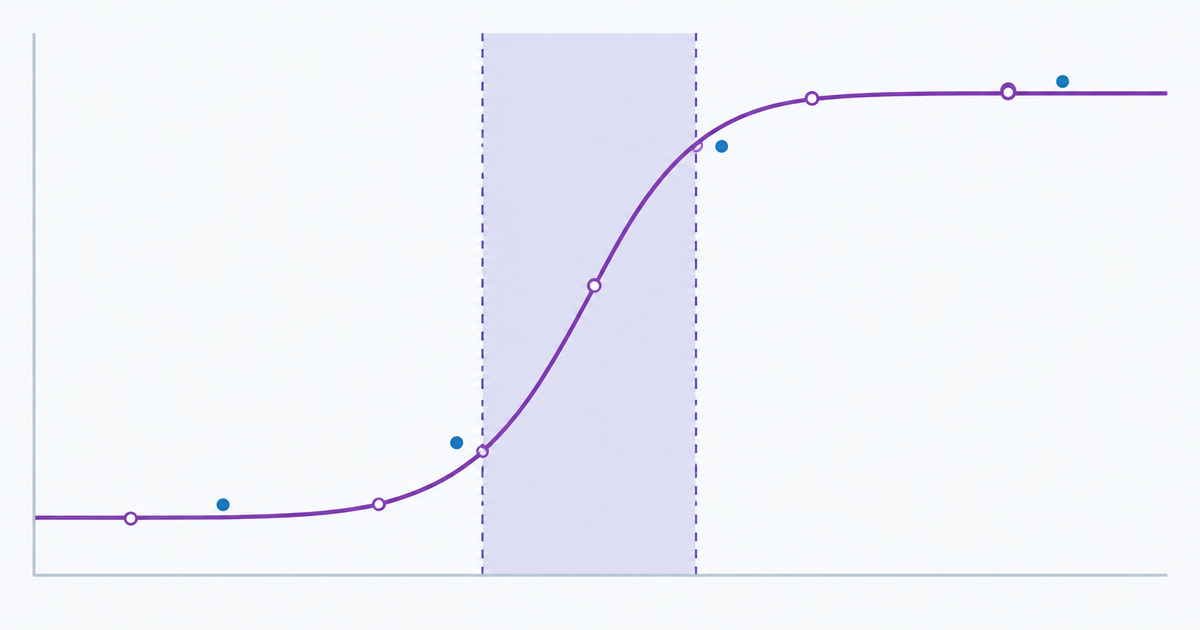
An ELISA curve is fitted using four- or five-parameter logistic models, not a straight line. Validation defines the working range, bounded by the lower limit of quantification (LLOQ) and the upper limit of quantification (ULOQ), within which accuracy and precision remain acceptable. Detecting a protein is different from quantifying it: below the LLOQ it may still appear, but the value is not reliable. Samples above the ULOQ are diluted and measured again, never estimated by extrapolation, and highly concentrated samples are also checked for the hook effect.
A decisive criterion for biological samples is parallelism. A real sample, serially diluted, must generate values that remain constant after dilution correction, behaving like the calibrator curve. When this does not happen, the endogenous protein differs from the calibrator or the matrix is interfering, and the assay must be reviewed before proceeding.
What changes from one day to the next
Small variations in time, temperature or lot should not change the result, and this robustness is assessed during development. Alongside it comes the stability of the protein in the sample, which is often decisive in preclinical research: samples are collected throughout the study, frozen and analyzed together. Knowing how many freeze-thaw cycles the protein tolerates, and how long it remains stable in storage, is part of ensuring that the final result represents the moment of collection.
Validation continues on every plate
A validated assay does not receive a permanent certificate. Every plate analyzed afterwards includes quality controls at known concentrations, and the run is only accepted when the curve and controls meet the established criteria. A change in antibody lot, species or sample type requires further verification: the partial validation described in ICH M10, to an extent proportional to the change. This continuity keeps the assay reliable from the first day to the last day of the study.
A result that carries through the project
The result of a well-developed and validated ELISA does not end in the report. It supports the decision to advance a molecule, informs subsequent phases and can be revisited years later, when the project reaches a regulatory stage. Every criterion demonstrated earlier is what makes it possible to trust that result at that moment.
Read the previous article in this ELISA series: ELISA in preclinical research: the choices behind a reliable result.